Web Design / SEO Redesign
Romdera.lt
The redesign Google had to like.
Web & product · Web Design · 2024
5 min read
- Year
- 2024
- Role
- Graphic & Multimedia Designer (Web Design)
- Context
- A 2024 website redesign for Romdera focused on search visibility, performance and turning the established brand into a stronger digital product.
- Outcome
- Delivered as a launch-ready website update with a clearer architecture, prototype-led interface and a foundation for post-launch measurement.
At a glance

Overview
The 2021 Romdera engagement built the brand. The 2024 Romdera.lt project asks a harder, more modern question: what if the redesign’s real client is Google?
The brief, explicitly: redesign the home-style restaurant’s website and improve its SEO performance – site structure, page speed, mobile responsiveness, and on-page SEO – to increase organic traffic and user engagement. This is not a visual refresh; it is a performance project wearing a redesign’s clothes, and it treats the design discipline as inseparable from technical SEO.
The work moved through a four-stage process – SEO Audit & Research → UX/UI Redesign → SEO Implementation → Performance Optimization – with the redesign delivered as an interactive Figma prototype and the updated site developed for launch and results evaluation.
Role
Graphic & Multimedia Designer (Web Design)
Client
Romdera – home-style food restaurant. The same Romdera whose 2021 branding engagement is covered separately; this project is the second chapter of the client relationship.
Scope
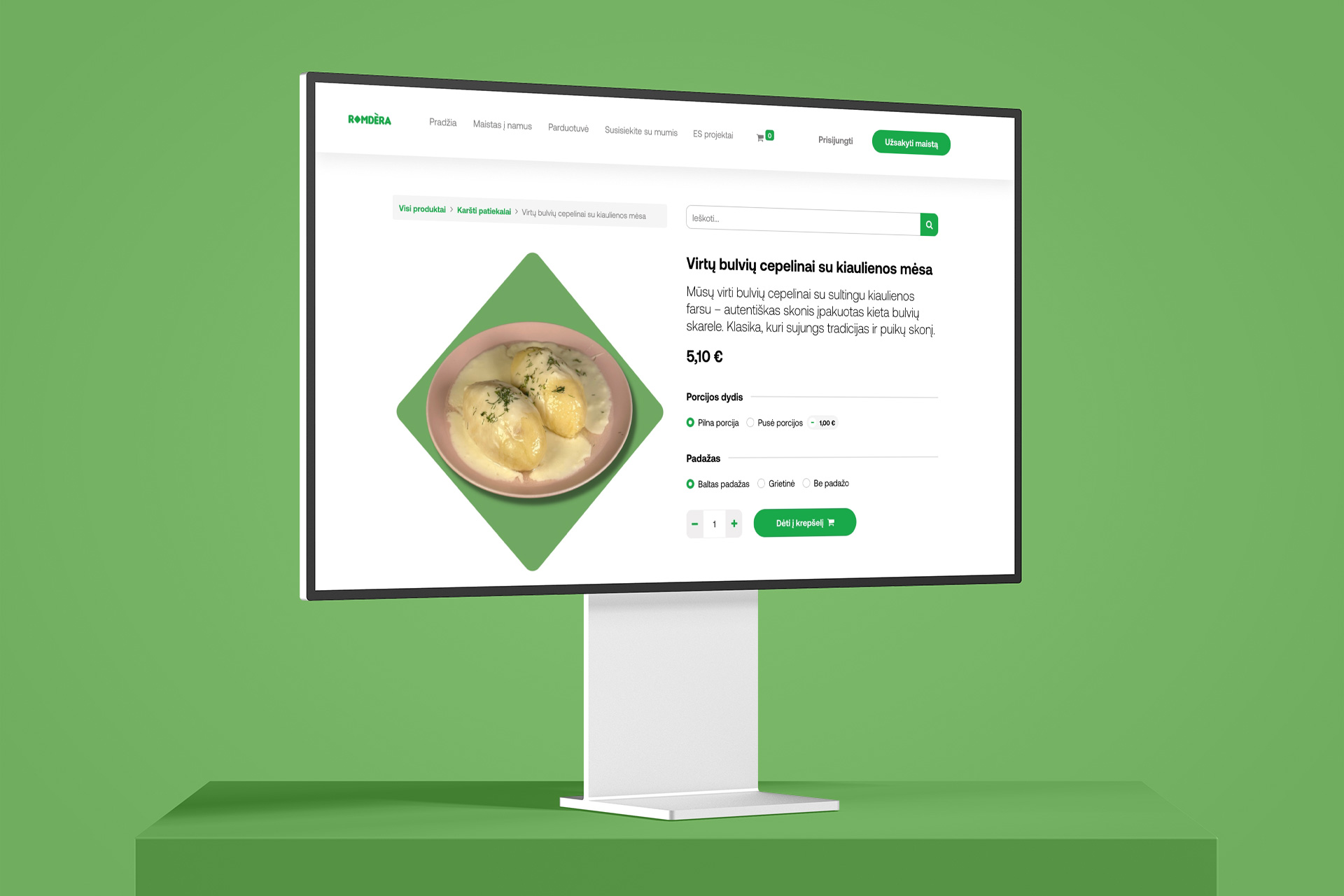
Full website redesign with an SEO performance mandate – structure, page speed, mobile responsiveness, on-page SEO. Four page types: Mainpage, Product Page, Menu, Contacts. Deliverable: interactive Figma prototype (v3), with the site update developed for launch and performance testing.
The starting point: what the audit found
The original site’s problems were enumerated with unusual honesty in the brief – a useful list, because it reads like a checklist of everything a small-restaurant website accumulates over years:
- Low search rankings for local food-related keywords – the restaurant invisible exactly when locals search “pietūs” nearby.
- Poor site structure and unclear navigation – the menu, the one page every visitor wants, not one tap from anywhere.
- Unoptimized images and slow page load – food photography at full resolution, punishing mobile visitors on 4G.
- Weak content hierarchy and missing SEO metadata – the machine-readable layer (titles, descriptions, structured data) that tells search engines what each page is.
- Inconsistent branding and outdated UI – eroding trust before the first dish photo loads.
Each of these maps to both a ranking factor and a UX failure – which is the thesis of the project: what’s bad for Google is bad for the guest.
Objectives
The redesign’s success criteria, as set at kickoff – each objective paired with what it really measures:
- Improve visual appeal and brand trust – the restaurant looking as good as its food, everywhere it appears online.
- Increase organic traffic through SEO – being findable at the moment of hunger: local search visibility.
- Enhance mobile responsiveness and UX – the phone experience treated as primary, not a desktop afterthought.
- Improve site speed and technical performance – load times that respect both the visitor and the search ranking.
- Increase online orders and customer engagement – the business metric all the above serves.
Architecture & pages
The new structure was deliberately minimal – four page types for a restaurant’s real decision journey:
Mainpage
Orientation: who, what, where, and the path to food.
Product page
The dishes themselves, structured so that each item carries clean metadata – the SEO layer that can surface a restaurant’s dishes in search directly.
Menu
The single most visited page on any restaurant site, given clear hierarchy, scannability, and fast-loading imagery.
Contacts
The local-SEO anchor: address, hours, phone, map – everything a “near me” search needs to convert.
Fewer pages, each doing more: a structure chosen for crawl clarity as much as for navigation – every page type maps to a distinct search intent.
Design & process notes
The four-stage method
The process sequence is the professional pattern: audit before design, design before implementation, implementation before measurement.
- SEO Audit & Research – establishing the baseline: what’s broken, what competitors rank for, which keywords the restaurant can realistically win.
- UX/UI Redesign – the visual and interaction layer rebuilt around the audit’s findings: clear navigation, content hierarchy, mobile-first layouts.
- SEO Implementation – the metadata, structure, and semantics layered into the design: clean URLs, page titles, descriptions, structured content.
- Performance Optimization – the speed work: image optimization, lean builds, fast loads on mobile connections.
Prototype-driven delivery
The redesign shipped as an interactive Figma prototype (Romdera Web v3) – the design system, page flows, and interactions testable before a line of production code. For a small business, prototyping first means the expensive development phase starts from an approved, clickable truth rather than from static mockups and guesswork.
Website showcase
Explore the webpage showcase below – click any thumbnail to open the gallery view.
Prototype
Explore the Romdera.lt interface
View the interactive design prototype in Figma.
Open Figma prototypeResults
The site update was developed for a spring launch, with performance testing and results evaluation to follow – the measured numbers (organic traffic change, page speed scores before and after, local keyword rankings, online order growth) will be added here when available. Qualitatively, the project delivered:
- A diagnosis-first redesign – every visual decision traceable to an audit finding, not taste alone.
- A four-page architecture aligned to search intent as much as to user navigation.
- A working method transferable to any small business: audit → redesign → implementation → measurement.
- The second chapter of a multi-year client relationship (2021 branding → 2024 redesign), where the designer’s role matured from making the brand visible to making it findable.
Lessons & reflections
- SEO is a design discipline. Structure, hierarchy, image weight, and metadata are design decisions with ranking consequences – treating them as someone else’s job produces the “beautiful but invisible” website this project was hired to fix.
- The audit makes the argument. A redesign justified by measured findings (slow loads, poor rankings, unclear navigation) is unarguable; a redesign justified by taste invites debate. Audit-first is how design gets the mandate.
- Small clients need the full professional loop too. The four-stage process – usually associated with agencies serving large accounts – adapted cleanly to a single restaurant website. Method scales down; craft doesn’t care about client size.
- Long clients are deep clients. Knowing the brand from 2021 made the 2024 redesign faster and truer: the second project inherits the first one’s context – the mark, the “der-” voice, the weekly-menu reality – and spends that capital on performance instead of re-establishing identity.
Credits & links
- Web design & SEO redesign: Lukas Sabaliauskas – Graphic & Multimedia Designer, Vilnius, Lithuania
- Client: Romdera – home-style food restaurant
- Figma prototype: Romdera Web v3 – interactive