Web Design / App Design / Interactive & Motion
Asteroids Neon Oblivion Game
Fair by design.
Motion & interactive · Interactive & Motion · 2026
10 min read
- Year
- 2026
- Role
- Solo – UX/UI design and engineering
- Context
- A solo-built, browser-playable reimagining of the 1979 arcade classic, developed as a complete product and UX exercise.
- Outcome
- Shipped as a live, local-first arcade game with progression, accessibility controls, mobile support and room for continued growth.
At a glance
Overview
Asteroids Neon Oblivion is a solo-built, browser-playable reimagining of the 1979 arcade classic – designed, engineered, tuned and shipped by one person, and treated not as a hobby artifact but as a full product exercise: hypothesis-driven research, documented UX decisions, an explicit tradeoff ledger, a persistence architecture, an accessibility system, and a procedural audio engine that synthesizes its entire soundtrack in the browser without a single audio file.
The architecture is a deliberate hybrid: HTML5 Canvas owns the game, and React owns everything else. The game loop – physics, collisions, rendering – runs on canvas; menus, HUD, settings, stats and overlays are React components layered above it. That split is the project's central engineering decision: canvas for frame-rate-critical game reality, React for the interface state machine around it.
Role
Solo – UX/UI design and engineering
Platform
Web – single-page React 18 + TypeScript application, HTML5 Canvas renderer with React UI overlays
Scope
- Game design and engineering – React + TypeScript, Canvas rendering, deliberately tuned physics
- Procedural audio – a Web Audio synthesis engine with no audio files in the bundle
- Local-first persistence – save/resume, stats, achievements, prestige and run history without a backend
- Accessibility system spanning every rendering layer – CSS, UI animations and canvas effects
- Status – live, complete, and architected for continued feature growth
The problem
The project opens with an honest diagnosis of its own genre. Classic Asteroids is instantly understandable – but two things tend to break fast.
- Readability collapses as chaos increases. As asteroids multiply and threats accumulate, the player stops being able to parse the screen – and deaths start feeling surprising rather than fair.
- Motivation fades after repeated runs. The original had no long-term goals, no personalization, no reason to return tomorrow.
The stated mission: keep the original's instantly-readable arcade feel, while adding save/resume, settings, accessibility and account-free progression. In other words – modern game UX without modern game bloat.
Research: hypothesis-driven, not persona-driven
For a solo build there are no stakeholders and no user research budget – so the project substituted a method: four testable assumptions, iterated against in playtesting.
- Readability breaks first – players need help tracking threats, boosts and danger states.
- Retention needs two loops – short-term "feel good now" and long-term goals.
- Agency reduces frustration – motion, FX, audio and control schemes must be adjustable.
- Web-first needs low friction – fast load, no backend dependency, mobile support.
Every feature that shipped maps to one of these four hypotheses – which is what turns a feature list into an argument.
Engineering detailsTechnical deep-dive
Architecture: canvas owns the game, React owns the interface
The codebase is organized as a main game-loop component surrounded by focused supporting modules – every concern with a proper home.
- Main game loop component – the frame-by-frame engine (delta-time loop; the ~5,000-line core, a documented tradeoff).
- Types and settings modules – the typed model of every entity, state and preference.
- Achievements and progression module – unlocks, prestige, timestamps.
- Audio synthesis module – the procedural engine behind the entire soundtrack.
- Utilities – drawing, physics, theme, particles, hazards: game logic decomposed by concern.
- UI helpers, a reduced-motion hook and an easter-eggs module – the interface layer and its secrets.
An entity taxonomy with a rule for everything
Primary entities: the ship; asteroids (variants including armored); player and UFO bullets; large and small UFOs; particles and debris; homing missiles; gravity wells; extra lives; rescue pods; solar flares; ship wreckage. Support entities: background stars and nebula, score popups, shockwaves, streak announcements, trails. Every object in the game has a type, a module and a rule.
Game-state flow
A clean state machine: menu, then countdown, then playing – with pause, dying and level-up branches – and game-over returning to the menu. The menu itself exposes the product: new game, continue, daily challenge, settings, stats, prestige, how-to-play. Game-over is a screen that earns a visit – detailed stats, unlocks review, prestige option.
The audio engine: synthesized, not shipped
A fully procedural Web Audio synthesis engine – no audio files in the bundle. For a portfolio, this is the detail that proves the point: the entire soundscape is authored in code, weightless, and infinitely tunable.
- Separate SFX and music busses – dual-bus routing.
- Gesture-activated audio context – browsers require a user gesture before audio; the engine handles it gracefully.
- Ambient layers that adapt with intensity – the music reacts to what's happening in the game.
- Pitch randomization to reduce fatigue – the same event never sounds exactly the same twice.
Persistence and data architecture
Fully local-first via localStorage, with a defined schema: settings, high score, mid-run save, stats, achievements, prestige, run history, secrets. The rules show product thinking.
- Save/resume with a 24-hour expiry – continue today, not forever.
- Run history capped at the last 20 runs – localStorage is finite and the app respects it.
- Export/import backups – the player owns their data and can move it.
- A "Danger Zone" with double confirmation – destructive actions fenced properly.
- Storage try/catch, migrations, audio resume and DPR resize handling – private-mode failures, schema evolution and device-pixel-ratio changes handled rather than hoped away.
And the data is shown back to the player: a stats panel with career stats, a radar chart and key-stats grid, a run-history area chart, and an achievement grid with filters and timestamps – data visualization applied to personal play history.
Performance and resilience
Frame-rate independence and failure states designed for, not discovered.
- Delta-time game loop – fast screens and slow screens get the same game.
- Memoization and density toggles – React re-renders controlled, particle load player-adjustable, an FPS option for weak devices.
- DPR resize handling – crisp on retina, correct on resize.
- Storage try/catch and settings migrations – failure states designed for, not discovered.
Game design: the loop and its depth
Core gameplay: thrust, rotate and fire in wrap-around space; asteroids split by size; circle collisions; invulnerability after death; shields that absorb damage; scoring with a combo multiplier – all on deliberately tuned physics constants. A designer's phrase that deserves underlining: the feel of a game is a set of numbers.
Difficulty as tuning, not hand-waving
Five difficulties – Cozy to Brutal – each changing lives, speed multipliers and boost-drop multipliers. Level pacing scales by formula: asteroid count grows as 3 + level, with speed scaling by level and difficulty. The challenge curve is math, so it's consistent.
Combat variety – the anti-monotony layer
- 5 boosts – Shield, Rapid Fire, Triple-Shot, Slow-Mo, Homing missiles – pickups with lifetime and bobbing, stackable with HUD timers and expiry warnings.
- UFO enemies, large and small, with movement patterns, AI shooting, unique scoring, distinct sound effects and rescue-pod drops.
- Environmental hazards – telegraphed solar flare sweeps, gravity wells and black holes, comets, armored asteroids and persistent wreckage.
Combo and kill streaks
Combos build from rapid kills and decay on a timeout, multiplying score; kill streaks track consecutive fast kills and trigger announcements and sounds. Both feed achievements and the flow-feedback layer – a scoring system designed to feel like momentum.
Progression without a backend
- 99 achievements across 5 categories with category titles, unlocked via end-of-run processing and mid-game checks, timestamps stored.
- 23 ship designs – each a unique canvas-drawn silhouette, unlocked by achievement count, plus a secret ship and custom image upload.
- 6 skins (cosmetic palettes for ship, glow and trails) and 14 themes, unlocked via achievement thresholds.
- Prestige system, unlocked at level 15+: resets run state, keeps achievements, stats and settings; prestige levels increase perk slots, and perks – extra life, starting shield, faster fire, more drops, magnetism – unlock across prestige levels. The idle-game meta-progression, transplanted into an arcade.
UX decisions, stated as decision and how
The project documents its UX reasoning explicitly – decision, then implementation – the format that separates designed products from assembled features.
Readability under chaos
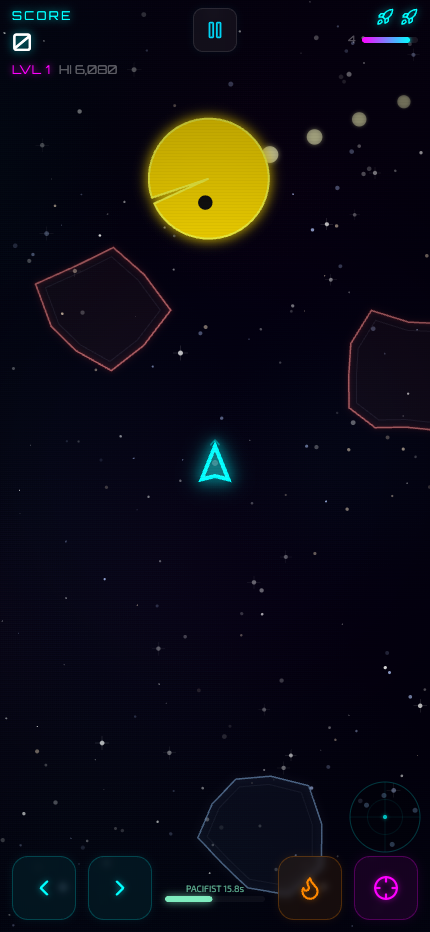
Keep the HUD minimal but information-rich – score, level, lives, boost timers, combo indicator – with optional radar/minimap and edge warnings to kill off-screen surprise deaths, and consistent urgency patterns: boost expiry blinks the same way every time.
Onboarding without killing momentum
Teach in layers, not a lecture – a multi-step How to Play overlay, dismissible contextual first-run tips, and tutorial completion persisted between sessions.
Agency via settings, with sane defaults
Four settings tabs – General, Effects, Themes, Cosmetics – exposing particle density, shake, trails, flash, CRT overlay, FPS, autofire and control scheme, plus a cheat input and settings migration. Players tune comfort, performance and difficulty; the defaults stay sane.
Accessibility done properly
Reduced motion is the project's signature accessibility decision – a 3-state system applied across every rendering layer, described in its own chapter below.
Mobile as first-class
Buttons or virtual joystick with multitouch, hold-to-focus for triple-shot, safe-area-aware HUD and responsive touch-target sizing. Mobile is not the desktop game shrunk.
Flow feedback loops
Every action gets responsive, rewarding feedback – combo and streak announcements, score popups, non-blocking achievement toasts, and cohesive audio-visual reinforcement.
Visual and interaction design
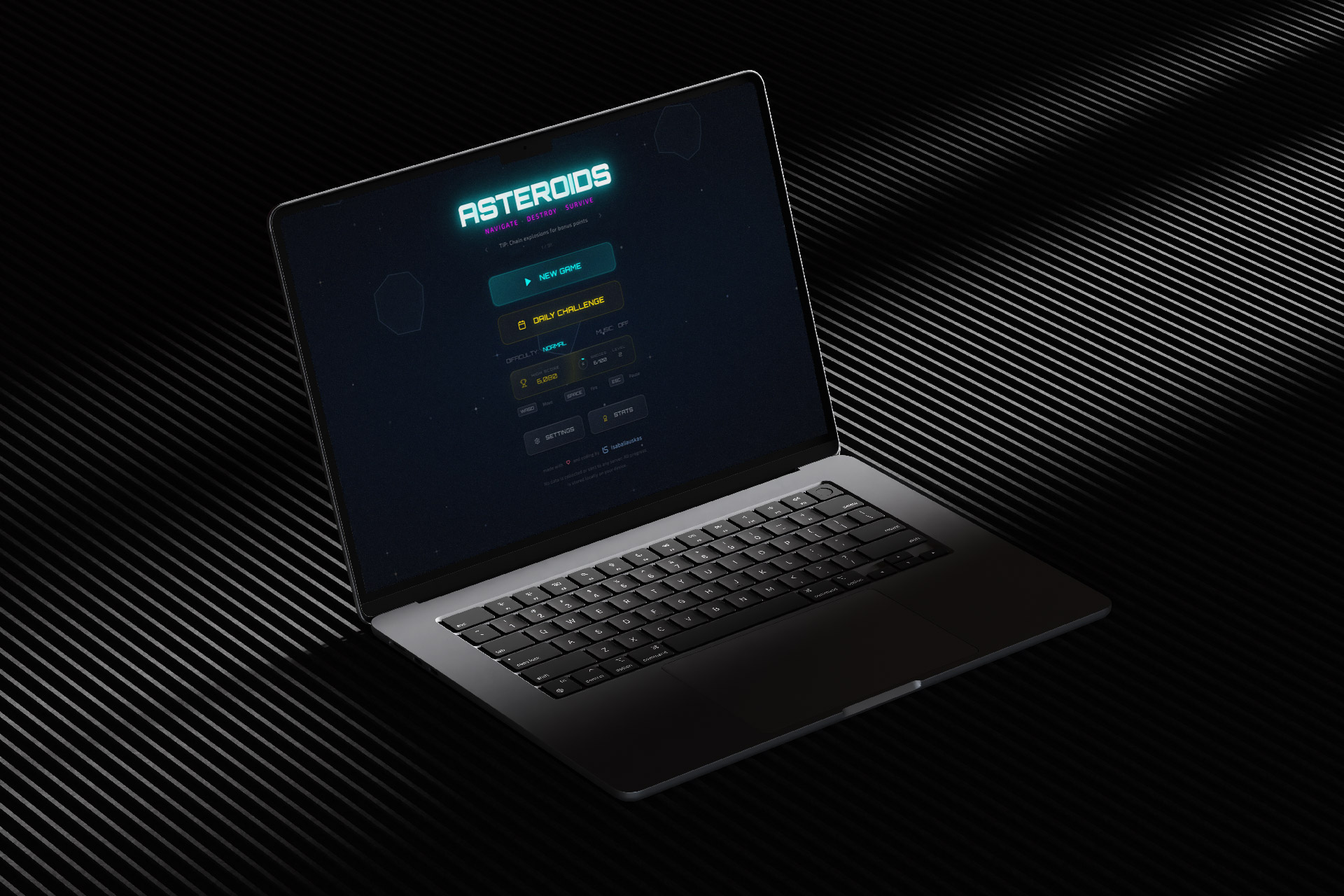
The identity is neon glassmorphism: frosted panels, glowing borders and theme-driven accent colors – the React layer reads as holographic glass floating over the canvas battlefield.
- Typography with two lanes – Orbitron for sci-fi display text, Exo 2 for readable UI text. Character and legibility given separate jurisdictions.
- The theme system as mood, not skin – 14 themes recolor ships, bullets, explosions, UI panels and background gradients together, with background interpolation by level and a special theme carrying extra UI styling.
- Arcade polish as a product feature – CountUp game-over stats, prismatic level-clear moments, an optional CRT overlay with scanlines, neon cursor and ripple interactions, parallax nebula, and a daily challenge designed as a "shared run" via seeded randomness.
- A real CSS and styling layer – Tailwind tokens, reusable glass panel and button styles, keyframes, theme-driven colors, responsive breakpoints and desktop-only enhancements. An interface system, not ad-hoc styling.
Interface showcase
Menus, HUD, settings, stats and progression – the React layer around the game, on desktop and mobile. Click any thumbnail to open the gallery view.
Playable experiment
Launch Asteroids
Open the browser-based game and play the experiment.
Play the gameAccessibility: the signature system
The most instructive decision in the project. Most "reduced motion" toggles in commercial software stop CSS transitions and call it done – leaving canvas effects, particles and shake untouched. Here, accessibility was designed across every rendering layer.
- A 3-state toggle – Off, System, On – respecting the OS preference by default while allowing explicit control.
- Applied across CSS, UI animations and canvas effects: particles, shockwaves, shake, flash, cursor trails, warp and confetti are all gated.
- While preserving informational feedback – damage and repair vignettes survive, because they tell the player something.
That distinction – disable the decorative, keep the informational – is the transferable principle, valid far beyond games.
The honesty ledger: documented tradeoffs
The project publishes what it chose not to do, with reasoning – the clearest signal of engineering maturity.
- No online leaderboards – local-first reduces friction; the cost (manipulable high scores) accepted for single-player.
- Customization increases UI complexity – contained via tab structure and strong defaults.
- A large core component (~5,000+ lines) – faster solo iteration chosen over maintainability; documented as a known issue and refactor target rather than hidden.
- localStorage limits – mitigated by capped run history and export/import backups.
Results
A modern, fully local-first arcade Asteroids – live, complete, and architected for continued feature growth.
- Readable at high intensity – HUD clarity plus optional threat-awareness tools; fair deaths by design.
- Motivating across sessions – achievements, unlocks, prestige, and a daily challenge designed as a "shared run": everyone playing the same day faces the same game, without a backend.
- Comfortable across devices – dual mobile control schemes, 3-state reduced motion, adjustable FX and audio.
- Fully local-first – save/resume and persistence with zero backend dependency.
Lessons and reflections
- Fairness is a designable property. "Deaths feel surprising, not fair" is the sharpest diagnosis in this portfolio – and telegraphed hazards, edge warnings and consistent urgency grammar are how it gets designed out. Every UX discipline that makes software humane makes games fairer.
- Hypotheses beat personas for solo work. Four testable assumptions, validated by playtesting, gave the project the rigor of a team process at one person's scale.
- Retention is an architecture, not a feature. Short loop, long loop, daily shared seed, prestige – the motivation system was designed as structure first, content second.
- Accessibility means auditing every rendering layer. A reduced-motion system that governs canvas effects, not just CSS, is the single most transferable idea here – for any product with dynamic visual content.
- Ship the honesty ledger. Documenting tradeoffs – the 5,000-line component, the leaderboards decision – demonstrates more judgment than any list of features can.
- Two-lane architecture, one product. Canvas for the game, React for the interface – knowing which layer owns what is what kept a solo project of this scale coherent.
Credits
- Product, UX/UI design and engineering: Lukas Sabaliauskas – Graphic & Multimedia Designer, Vilnius, Lithuania